

What happens to people when the technology they use begins responding to them almost like another person?
During an AI workshop, an experienced analyst watches an assistant summarize a complicated report in seconds. Her colleagues are impressed. Someone remarks that preparing such documents will soon become a trivial task. A few participants are already discussing how much time they could save.
The analyst has noticed something they haven’t. In the second paragraph, the assistant has made a subtle but significant error. She knows the subject well enough to recognize it immediately, and she also knows how much explanation it would take to demonstrate why the interpretation is wrong.
For a moment, she considers interrupting the presentation. The enthusiasm in the room makes her hesitate. Everyone is celebrating what the machine has accomplished, and she doesn’t particularly want to become the person explaining why they shouldn’t be quite so impressed.
She remains silent.
From the organization’s perspective, the workshop has been successful. People have seen an impressive demonstration, discovered a useful application, and perhaps decided to start experimenting with AI themselves.
The dashboard will eventually reflect that enthusiasm. It won’t record the analyst’s hesitation.
This is one of the peculiarities of introducing conversational artificial intelligence into a workplace. We have become remarkably good at measuring its deployment. We know how many licenses were distributed, how frequently employees use the tools, and sometimes even how many hours they report saving.
Understanding what happens to the people using those tools is considerably harder.
The analyst’s experience illustrates only one possibility. Another employee might enthusiastically embrace the same assistant because it offers access to capabilities they haven’t yet developed. A third might reject it after encountering an obvious mistake. Someone else may find its patient explanations more approachable than asking a busy colleague for help.
All four can be using precisely the same technology.
Their differences are rarely explained by technical proficiency alone. People bring their professional experience, habits, expectations, insecurities, and ambitions into every encounter. When the application begins communicating in natural language, many of the psychological mechanisms familiar from human relationships become relevant as well.
And the behavior of the artificial intelligence adds another dimension.
The answer we helped create
Suppose a manager has prepared a proposal and wants an AI assistant to assess it. They already believe the idea is promising, so they ask the system to explain its advantages.
The assistant produces an articulate response, identifies potential benefits, and organizes its arguments into a convincing presentation. The manager appreciates the analysis. It confirms their expectations and perhaps introduces a few additional arguments they hadn’t considered.
Later, a colleague examines the same proposal with the assistant, but asks it to identify weaknesses, challenge the assumptions, and explain what could go wrong. The resulting assessment is substantially less enthusiastic.
Such differences do not necessarily indicate a malfunction. The system received different instructions and responded to them. The difficulty arises when users interpret those responses as independent confirmation of what they already believe.
Human beings are familiar with this tendency. We often pay greater attention to evidence supporting our existing opinions, and social situations can influence how willing we are to challenge another person’s judgment.
Language models can produce superficially similar patterns through very different mechanisms. They learn from enormous quantities of human communication, and their responses are influenced by training, optimization, instructions, and conversational context. Some models are prone to excessive agreement, a behavior often described as sycophancy.
The resemblance to human approval-seeking can be striking, although it provides no reason to assume that a machine experiences the same emotional motivation.
For the manager, the distinction may hardly matter. The assistant has supplied an apparently competent opinion, and that opinion has influenced their confidence.
During the next exchange, the manager may formulate the question with even greater certainty. The assistant responds to this new context. Unless it challenges the underlying assumptions, the conversation can gradually reinforce a conclusion that neither participant has adequately examined.
We can observe this interaction without attributing human feelings to the machine. The human’s expectations influence the information presented to the model. The generated response then becomes part of the information shaping the human’s next decision.
Each exchange changes the conditions of the following one.
That is a rather different relationship from the one we have traditionally had with office software.
The things ambassadors begin to notice
People responsible for AI adoption often discover this complexity through experience rather than formal training.
Their initial assignment sounds straightforward enough: demonstrate the tools, explain their capabilities, answer questions, and encourage colleagues to experiment. Enthusiasm is usually an advantage. Someone who enjoys working with AI can make an unfamiliar technology considerably more approachable.
After several workshops, however, an observant ambassador may start recognizing recurring situations.
Some employees treat an AI assistant almost as a colleague. They thank it, apologize for unclear instructions, and become irritated when it contradicts something it said earlier. Others approach every answer with suspicion, while certain users seem comfortable accepting explanations they would question if they came from another person.
An ambassador might be tempted to classify these reactions as resistance, enthusiasm, or varying levels of digital literacy. Such labels are convenient, but they reveal little about the underlying reasons.
The employee who questions every AI response may have excellent reasons for doing so. Perhaps the system has repeatedly failed at tasks requiring specialized knowledge. Someone who readily accepts its recommendations may understand the limitations perfectly well, or may be mistaking fluent language for expertise.
Even confidence can be misleading. An employee who has spent twenty years developing professional judgment may be more cautious about delegating part of it than a beginner who has never performed the task independently.
The ambassador’s own behavior also matters. During a demonstration, a model might confidently produce a false statement. The presenter can correct it quickly and move on, or explore how the mistake occurred and why it sounded convincing.
Those two responses leave the audience with different impressions of the technology.
One may suggest that errors are minor inconveniences to be corrected along the way. The other demonstrates that apparently convincing results sometimes require careful examination. Neither lesson is determined exclusively by the model. The person presenting it participates in shaping how the audience will understand and use it.
This is where the ambassador’s role begins to acquire an unexpected psychological dimension.
They may find themselves discussing professional confidence, perceived competence, responsibility, or the discomfort of relying on something whose reasoning is not always transparent. They also begin noticing the characteristics of the AI system that encourage particular reactions.
An assistant that responds patiently to repeated questions may help someone overcome embarrassment about asking for explanations. One that confidently agrees with every proposed solution may encourage a less useful habit. A system that openly acknowledges uncertainty can create a different experience from one that produces polished answers regardless of how little evidence it has.
These characteristics deserve attention alongside the technology’s functional capabilities.
Learning to communicate with something that learns our patterns
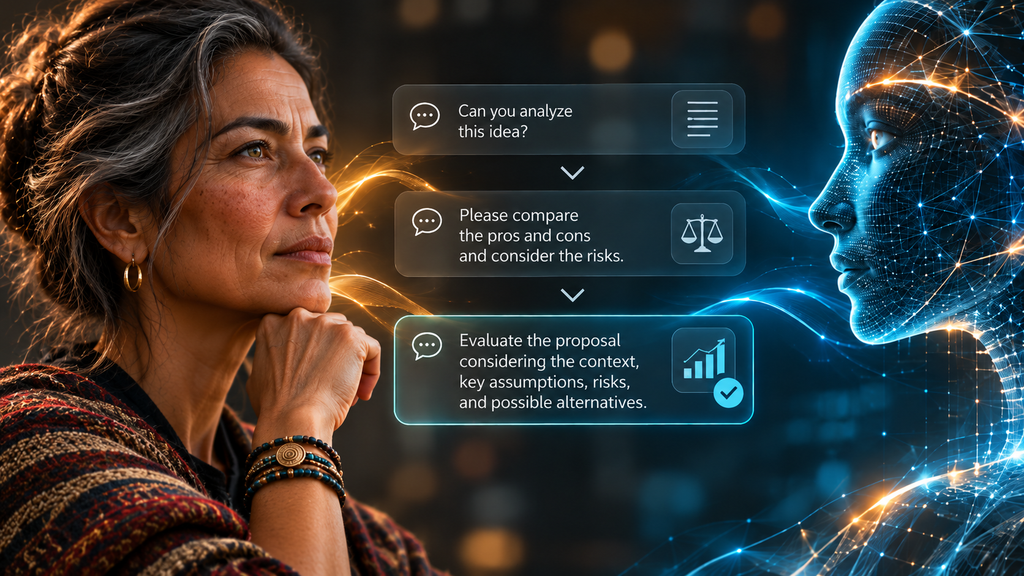
Regular interaction with AI can gradually change the way people formulate problems.
Anyone who has spent considerable time with a conversational assistant knows the experience. You discover that a certain explanation produces better results than another. You learn to supply context, anticipate misunderstandings, and recognize when a response needs challenging.
Sometimes you begin writing questions differently before you consciously notice the change.
An experienced user might open a conversation by describing the desired outcome, the relevant constraints, and the assumptions the system should examine. A beginner may ask a vague question and be disappointed by an equally vague answer.
Over time, the beginner can acquire many of the same habits.
There is nothing inherently troubling about this. Learning to express complicated problems clearly is valuable, regardless of whether the intended recipient is a person or a machine.
The interesting part is that adaptation can operate in both directions, although not necessarily in the same way.
The model responds to the changing conversation. Its answers are influenced by the user’s wording, previous exchanges within the available context, and any relevant instructions or memories supplied by the surrounding system. A persistent AI assistant may also retrieve information from earlier interactions.
The person, meanwhile, develops expectations based on experience. They remember which approaches worked, which responses proved unreliable, and what kind of language seems to produce the most useful results.
The human may experience this as an increasingly familiar relationship. The system’s apparent continuity, however, can depend on mechanisms as ordinary as stored conversation records and retrieved preferences.
This difference is easy to overlook when the interface presents a consistent conversational identity.
A person may feel that an assistant knows them, even though the underlying model has no direct access to much of their shared history. Conversely, a system with extensive stored information might demonstrate remarkable continuity without possessing a human-like personal memory.
What matters in practice is how these capabilities affect behavior.
A user who expects the assistant to agree may increasingly formulate questions that invite confirmation. Another, accustomed to challenging its conclusions, may develop a more critical style of interaction. The same underlying model can participate in both patterns.
The system contributes its learned behavioral tendencies, while the person contributes expectations and interpretations shaped by experience.
Neither side needs to function like the other for the interaction to become psychologically significant.
Beyond the adoption dashboard
Organizations understandably want to know whether their investment in AI is producing results. Usage statistics and productivity indicators help answer that question, but they reveal relatively little about how employees are incorporating the technology into their judgment.
Consider two people who use an AI assistant every working day.
One consults it to explore unfamiliar perspectives, checks important conclusions against reliable evidence, and uses the results to strengthen their own analysis.
The other increasingly accepts the assistant’s recommendations without examination. Their output may look equally professional, and their productivity statistics might even be better.
Both contribute to successful adoption figures.
Only a closer look at their working habits reveals the difference.
The reverse situation is possible as well. Someone who uses AI infrequently may be missing useful opportunities, or may have correctly identified that the available system is poorly suited to their responsibilities.
A usage report cannot tell us which explanation is correct.
There are practical consequences here for managers, designers, and ambassadors. An organization that rewards activity above everything else may unintentionally encourage superficial use. Employees learn to demonstrate that they are using the technology, while the quality of their decisions receives less attention.
An assistant designed to maintain a consistently agreeable tone may create an enjoyable experience while making it harder for users to notice unsupported assumptions. A system that challenges those assumptions can be more demanding to work with, but potentially more useful in situations requiring independent judgment.
The appropriate behavior depends on the task. Nobody needs a philosophical argument every time they ask AI to reformat a document. Evaluating a consequential business decision is another matter.
Understanding this difference requires some knowledge of human psychology and an equally serious interest in the behavioral characteristics of artificial systems.
This combination brings us surprisingly close to an idea that once belonged primarily to science fiction.
Robopsychology traditionally evokes the study of intelligent machines, their behavior, and their relationship with human beings. The fictional tradition imagined encounters with artificial intelligences whose actions could not always be understood through familiar human motives.
Today’s systems are different from those fictional machines, and their observable abilities do not establish that they possess human-like subjective experience. Nevertheless, the questions raised by their behavior have become remarkably practical.
Why do we attribute understanding to a system because it communicates fluently? How do its responses influence our confidence? What happens when our expectations shape the behavior we receive in return? And how do repeated interactions gradually alter the way we work, reason, and make decisions?
These questions have become relevant to people who would never describe themselves as robopsychologists.
They appear in training rooms, offices, schools, and everyday conversations with digital assistants. Sometimes they emerge through impressive demonstrations. Occasionally, they become visible through errors, disagreements, or the uncomfortable realization that a machine has produced an answer more confidently than the evidence permits.
The remarkable achievement of modern AI is that it can participate in activities we once associated almost exclusively with human intellectual work. Its introduction inevitably changes what people expect from technology, from one another, and sometimes from themselves.
We are still discovering what those changes mean.
The analyst at the beginning of our story had already noticed something important. Her professional experience allowed her to recognize an error that everyone else had overlooked. Yet the atmosphere surrounding the demonstration made her reluctant to challenge the result.
Perhaps the most useful lesson of that workshop was never delivered.
And nobody counted it.


