
What we believe about people and artificial intelligence can influence how both behave the next time they meet.
Before a project meeting, a manager receives a short briefing on the colleagues who will be attending. One is described as imaginative and enthusiastic about AI. Another is experienced, technically capable, and skeptical of the company’s new assistant.
During the meeting, both question a recommendation generated by the system. The first suggests exploring another option. The second wants to know whether the assistant had enough information to support its conclusion. The manager welcomes the suggestion as creative thinking, then asks the skeptical colleague to approach the technology with a more open mind.
The questions deserved consideration on their own terms. Instead, each has been interpreted through a description supplied before anyone entered the room. Over the following weeks, the first colleague is encouraged to experiment and grows comfortable proposing unconventional ideas. The second becomes careful about raising objections, having learned how readily they are interpreted as resistance. Eventually, their behavior appears to confirm the manager’s original impression.
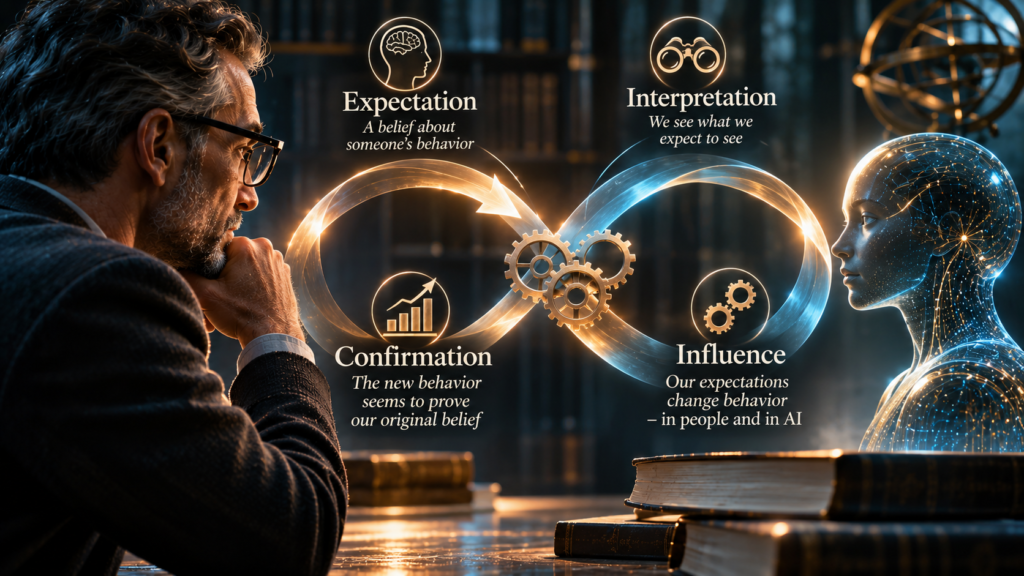
The briefing may have been accurate when it was written. That is what makes the situation difficult. Expectations can influence which actions we notice, what we think those actions mean, and how we respond. Our response then becomes part of the conditions shaping the next interaction.
Conversational AI introduces a second source of apparent behavior into this familiar human process. A machine may sound patient, stubborn, competent, or overly agreeable. People explain these impressions using the language of personality, while the responses themselves are affected by the model’s training, its instructions, the conversational history available to it, any retrieved information, and the questions people ask. As users adapt to the system, their new expectations influence what they ask next.
A third person observing the exchange may see only the resulting pattern. It can be difficult to tell where a behavior began, and easier still to give it a convincing name.
Five situations reveal what happens when such explanations begin influencing the reality they were meant to describe.
1. Resistance: A boundary mistaken for an obstacle
A department introduces an AI assistant to help managers prepare annual employee evaluations. It turns scattered notes into readable summaries, suggests development goals, and produces the balanced, professional language that formal assessments often require. Several managers welcome the convenience, particularly at the end of a demanding year.
One department head refuses to use it for this purpose. She is neither unfamiliar with AI nor opposed to it: she uses the same assistant for research, scheduling, and routine correspondence. But she writes performance evaluations herself, and the project report records her as reluctant to adopt the new workflow.
The classification seems straightforward until someone asks what, precisely, she objects to. Her concern is not that the machine might produce an awkward sentence. It is that a fluent evaluation can make a judgment sound better founded than it is. A tactfully phrased criticism may conceal a serious management problem; a reassuring paragraph may make an unresolved disagreement appear settled. She is responsible for the evaluation and worries that accepting the language too readily will influence how she considers the employee behind it.
There may be other reasons for her decision. Familiarity, professional pride, an uncomfortable experience with a previous system, or a desire to retain control could all contribute. Some of those reasons would be worth challenging. Others may identify genuine problems in the proposed process. The refusal, taken alone, cannot distinguish them.
The assistant has a role in this uncertainty. Its ability to produce complete, polished language makes the workflow attractive, but polish can obscure how much judgment remains to be done. A manager who relies on the generated draft might still review every factual claim, or might gradually begin treating a plausible formulation as a completed assessment. The interface does not tell an outside observer which habit is developing.
Now suppose the department head’s refusal is treated primarily as a problem of attitude. She is offered another demonstration and encouraged to be more positive about innovation. When she raises concerns about responsibility, colleagues hear them as further evidence of her reluctance. After a while she contributes less to discussions of the tool, and the project team loses access to an informed objection that might have improved the workflow.
Her withdrawal can then be entered into the next adoption report as confirmation that she remains resistant. The organization helped create the silence it now interprets.
Resistance is a real human response, and it sometimes prevents worthwhile experimentation. Yet so are professional boundaries, reasoned objections, and the wish to remain accountable for consequential decisions. Calling them all resistance may be convenient for reporting; it is a poor substitute for understanding why someone has drawn a line.
2. Anthropomorphism: How a team invents an AI personality
The communications department has acquired a reputation for working with an unusually cautious AI assistant. It happened gradually. During the first weeks, the system repeatedly proposed restrained headlines, warned against unsupported claims, and softened language the editors thought perfectly acceptable. Someone called it the cautious one, and the nickname stuck.
At meetings, people began predicting how the assistant would react before anyone opened the application. Colleagues shared examples of its objections and joked about its inability to enjoy a provocative headline. New members of the team were introduced to the assistant with a warning: it would probably try to make everything safer and duller.
The reputation was not entirely invented. The assistant had been configured to work within the organization’s editorial and compliance requirements, and some of its recommendations genuinely favored conservative wording. But a subtle change followed the team’s adoption of the label. Editors increasingly opened conversations by arguing against objections they expected to receive. They wrote prompts such as, “I know you’ll want a conservative version, but try something bold.” Some began storing examples of successful prompts in a shared guide, complete with advice for handling the assistant’s alleged caution.
A new employee eventually questioned the description. In a fresh conversation, without the team’s usual framing, she asked for several headline styles for the same campaign. The assistant supplied cautious options alongside much more adventurous ones. This single test did not prove that the system was never biased toward restraint; a different prompt and context could readily produce different outputs. It did, however, challenge the claim that caution was a fixed characteristic of the assistant.
By then the supposed personality had become a piece of organizational knowledge. People passed it on in conversation, incorporated it into working habits, and interpreted unusual responses as exceptions to the rule. Even colleagues with little direct experience of the system knew what sort of character they were dealing with.
This is more interesting than one individual giving a chatbot a name. A group has developed a shared interpretation of an artificial agent, and that interpretation has begun coordinating the group’s behavior. The collective expectation influences prompts; the resulting outputs supply new anecdotes; those anecdotes keep the reputation alive.
Human teams do something comparable when reputations form around colleagues. A person repeatedly described as difficult may be approached defensively, creating precisely the tense interactions others were expecting. With AI, the mechanisms on the other side of the conversation are different. The model need not possess a stable temperament or personal motives. Its output may reflect instructions, retrieved policies, and conversational context, alongside patterns learned during training. In an ordinary conversation, a change in response does not mean the underlying model has learned a new personality. The application may also preserve preferences or retrieve earlier exchanges, creating continuity across sessions without retraining the model.
That difference does not make the team’s experience imaginary. The assistant really did produce the words they saw, and the workflow built around it is real. What deserves examination is how much of the familiar character belongs to the system’s configuration, how much comes from repeated prompting, and how much exists in the social story the team tells about it.
An update to the assistant could disturb that story overnight. It might also leave the reputation intact if editors continue asking questions in ways that invite the same responses. By then, changing the software alone may no longer be enough to change the experience of working with it.
3. Overtrust: The decision made before anyone voted
A procurement committee is choosing a supplier for a long-term service contract. Its members know their market and understand the consequences of selecting the wrong partner. To save preparation time, they ask an AI assistant to create an evaluation framework using the material collected from prospective suppliers.
The assistant produces a tidy comparison: price, delivery capability, previous experience, service availability, and contractual flexibility. It proposes weights for the criteria and places the suppliers into a scoring table. The committee discusses the result seriously. One specialist corrects an outdated price, another challenges a delivery estimate, and a third adjusts the score assigned to a supplier’s experience. Nobody in the room is treating the generated figures as unquestionable.
The discussion is productive. What it never reaches is the cost of maintaining the service under exceptional operating conditions. That omission matters for this particular contract, but it was absent from the criteria supplied by the assistant and never added by the committee. Their scrutiny improved the answers within the framework while leaving the framework itself largely untouched.
This is a less obvious form of reliance than copying a confident AI response into a report. A team can challenge individual conclusions vigorously while accepting the system’s initial choice of what deserves attention. The members may feel they have retained control because they made the final decision and corrected the machine several times. In an important sense, they did. But the earlier act of defining the problem had already been delegated.
The same effect exists without AI. Meeting agendas shape conversations; a poorly designed form limits which information can be entered; a spreadsheet template encourages decisions using the categories it contains. Generative AI can supply these structures so quickly and fluently that the act of choosing them almost disappears into the preparation of the work.
Its language adds another influence. Coherent explanations make categories seem purposeful, and a complete-looking table discourages the search for what is missing. None of this means the model deliberately guided the committee toward a particular supplier. The consequences arise because a plausible structure can organize human attention before its assumptions have been examined.
Imagine an outside observer reviewing the meeting. They see experts question figures, correct errors, and debate the recommendation. They might reasonably conclude that this was an example of responsible AI use. They would be right about much of what happened, while still missing the decision that shaped everything that followed.
Overtrust is often treated as a personal tendency: someone believes the machine too readily. In professional settings, reliance is usually more uneven. We may distrust generated facts yet accept generated categories, question a proposed ranking yet assume the important alternatives have been included, or reject the conclusion while retaining the structure of the argument.
The contract may still go to the best supplier. An omitted criterion does not guarantee a bad outcome. It does mean that the committee’s confidence in its method deserves a different kind of scrutiny. The most consequential influence of AI may have occurred before the experts began checking its answers.
4. Cognitive dependence: Who gets the first thought?
For a junior landscape designer, an AI assistant initially feels like an extraordinary extension of professional curiosity. It helps compare planting requirements, explore unfamiliar species, estimate maintenance demands, and find alternatives worth investigating. The designer still verifies technical information and makes the final choices, but the early stages of a project become faster and less intimidating.
Within a year, a routine has formed. Each new commission begins with a description of the site and a request for a preliminary concept. The assistant proposes a layout, identifies constraints, and suggests priorities. The designer revises the proposal, replaces unsuitable ideas, and develops it into a detailed plan. Their colleagues are pleased with the results.
One afternoon, a senior designer asks for a quick initial sketch before the assistant is consulted. The junior colleague hesitates. They are accustomed to responding to a structure supplied by the system, and beginning without one feels unexpectedly difficult.
That hesitation does not establish a loss of intelligence or professional competence. The designer may be learning through revision, developing a stronger eye for weaknesses, and tackling more ambitious commissions than before. Yet the episode exposes a change in the order of their thinking. The first interpretation of a site, once an exercise in independent judgment, often arrives ready for review.
Consider what that first interpretation involves. Before drawing a path or selecting a tree, a designer decides which features of the place matter: sunlight, drainage, soil, patterns of movement, expected maintenance, and the experience the space should create. An initial concept is an attempt to organize those considerations into a coherent problem. It may be wrong, but working through its weaknesses is part of how professional intuition develops.
People have always transferred mental work to tools. Notes compensate for memory; maps support spatial reasoning; calculators remove tedious arithmetic. Cognitive offloading can leave more attention available for difficult decisions, and abandoning useful tools merely to preserve every old habit would make little sense.
What distinguishes a generative assistant is its flexibility at the beginning of the reasoning process. It can propose not only possible answers but also the questions, categories, and priorities from which an answer will emerge. The user’s role can shift toward evaluating an intellectual structure they did not create.
Another designer might use the same model differently. She begins with an imperfect proposal of her own, then asks the assistant to identify overlooked constraints and argue for alternatives. The resulting conversation may broaden her thinking precisely because she has something to defend, revise, or abandon. Neither workflow is automatically superior. The first designer could develop considerable expertise through careful comparison; the second could cling stubbornly to initial assumptions despite the evidence provided.
The distinction becomes more consequential when the workplace adapts to the tool. Once AI-assisted concepts are expected by the end of the morning, taking time to explore an independent idea may appear inefficient. A team can gradually organize its deadlines, reviews, and definition of productivity around the assumption that a machine will provide the starting point.
Then the technology’s influence is no longer confined to one person’s habits. The organization may begin offering fewer opportunities to practice an activity that previously helped newcomers learn. Managers see faster output and infer greater capability, while the distribution of reasoning inside the process becomes less visible.
There may be real gains: less repetitive research, more time for site visits, better comparison of alternatives. There may also be skills that receive less exercise. The sensible question is how those effects develop together, rather than whether every use of AI is evidence of empowerment or dependence.
If we want to understand the designer’s progress, counting completed plans will not be enough. Their ability to interpret an unfamiliar site, defend a choice, recognize an omission, and learn from a failed proposal matters too. Some of those abilities may be enhanced by the assistant. Others could quietly become less practiced if the first move is always made on the designer’s behalf.
5. Professional identity: The expertise nobody can see
For fifteen years, a technical writer has produced documentation for industrial equipment. The job demands more than accurate prose. They consult engineers, examine previous failures, interpret technical standards, and work out how a procedure will be understood by somebody operating unfamiliar machinery under less-than-ideal conditions.
An ambiguous instruction can be dangerous even when every individual sentence sounds sensible. Over time, the writer has learned to spot missing details that people without direct experience of the equipment might never think to ask about. That judgment is part of why colleagues trust the finished documents.
A new AI application begins generating competent first drafts in minutes. The writer is pleased with much of the output: routine sections are easier to prepare, the language is consistent, and there is more time to investigate difficult passages. They review the material, correct technical details, consult specialists, and ensure that procedures are suitable for their intended use.
Management notices a different change. Where preparation once took days, a polished document now exists almost immediately. The remaining verification work begins to look like a delay between the moment the product appears finished and the moment it can be released.
At a planning meeting, someone asks why so much time is still being allocated to documentation. The AI has already done the writing. Could the team simply check it more quickly?
The question is understandable; organizations should examine whether new tools can reduce unnecessary effort. The difficulty is that generating convincing language and validating operational instructions are different activities. The most consequential part of the writer’s expertise may involve problems absent from the draft: a missing safety condition, an unrealistic maintenance sequence, an assumption about access to a component. These omissions can be difficult to demonstrate until someone notices what ought to have been included.
The visible evidence of productivity has changed faster than the organization’s understanding of the work. A first draft becomes easy to produce, while the judgment required to approve it remains demanding. Yet the fluency of the generated document can make that judgment appear less valuable.
Professional identity is partly formed through recognition. People learn not only what they can do but what others rely on them to do. When a machine reproduces the visible result of years of practice, colleagues may begin questioning the need for the person who previously produced it. The specialist can experience that change as a threat to professional status even when they welcome the technology’s practical benefits.
Such uncertainty cannot be dismissed with the promise that AI will never replace human expertise. Some tasks will be automated, roles will change, and organizations may genuinely need different capabilities. In this example, too, some verification steps may become more efficient through improved processes or tools. The question is whether the organization understands which responsibilities remain before it changes the expectations surrounding them.
Suppose the writer repeatedly explains why apparently finished drafts need substantial review. Managers begin interpreting these objections as reluctance to modernize. Project schedules become tighter, and careful verification attracts less praise than rapid production. A junior colleague sees that the safest professional choice is to avoid raising concerns unless a defect is unmistakable.
The writer may eventually stop arguing over unrealistic deadlines. Management then sees fewer objections and becomes more convinced that the work had been overcomplicated all along. An initial misunderstanding has altered the conditions under which expertise is exercised, making the misunderstanding harder to challenge.
The consequences reach beyond one employee’s self-image. They affect which forms of knowledge are recognized, which warnings are heard, and which standards a team is willing to defend. AI has changed the production process, but people’s interpretation of that change is also reshaping the profession around it.
There is a special irony here: the better an artificial system becomes at producing the visible signs of expertise, the easier it may be to overlook the human expertise needed to judge what those signs actually mean.
When a description becomes a design decision
The manager from the opening meeting did not intend to silence a colleague. The briefing may have reflected genuine past experience, and encouraging constructive participation is reasonable. The difficulty arose when a tentative description was treated as a reliable explanation of everything the colleague subsequently said.
There is a further consequence once such interpretations enter the systems around us. Imagine an organization that classifies complaints about its AI assistant as evidence of inadequate prompting skills. Training materials are revised, employees receive examples of better instructions, and the number of complaints eventually falls. The result looks encouraging. But perhaps some users have stopped reporting problems because their previous concerns were dismissed. The system’s behavior has not necessarily improved, although its apparent reception has.
The opposite error is possible too. A support team may attribute every confusing interaction to a faulty model and overlook the unclear expectations established by an interface or workplace policy. Engineers can spend weeks adjusting a service while the circumstances producing the complaints remain unchanged.
In each case, an explanation has crossed an important boundary. It is no longer just someone’s opinion about what happened; it now determines which evidence gets collected, which interventions are attempted, and what will count as success. An AI agent’s developers might convert those interpretations into new instructions, retrieval rules, or evaluation criteria. The organization would then begin engineering the very behavior its earlier reports claimed merely to observe.
We cannot work without assumptions, and many expectations are useful products of experience. What matters is whether the next unexpected result is allowed to challenge them. A well-established reputation, a successful dashboard, or a convincing AI response should remain open to evidence that it has been misunderstood.
Back in the meeting, two colleagues have raised different questions about the same machine-generated recommendation. The manager can respond to the reputations attached to the speakers or examine what each question contributes. Nothing in the assistant needs to change for those choices to lead to different conversations, different working relationships, and perhaps a different decision.
That is part of the behavior a robopsychologist must account for. The explanations people give about humans and artificial systems do not always remain outside the interaction. Sometimes they become the conditions under which the next interaction takes place.